
Day 160 - From the Valley of Roses to the Sahara Desert
After a somewhat comfortable sleep at the Rose Valley Hotel in Morocco’s famous Valley of Roses, the alarms were going off early again. We had to be up at 6:30am, packed, dressed and downstairs for breakfast by 7. We wanted to beat the rush because there were heaps of people from different tours all staying at the same place, and we still had a few last-minute bits to sort before leaving for the Sahara.
The Valley of Roses, near Kalaat M’Gouna, is one of Morocco’s most famous rose-growing regions, known for its annual Rose Festival, rosewater production and endless stretches of Damask roses that bloom each spring. The region sits along the “Road of a Thousand Kasbahs,” where ancient fortified villages and fertile valleys break up the harsh desert landscapes. Even though we were only there briefly, it felt like one of those places with much more history than a quick overnight stop could ever reveal.
Breakfast was traditional Moroccan and pretty simple: boiled eggs, the round flat breads that seem to appear with almost every meal here, roti-style square breads, jams, honey, oranges, apples, orange juice and coffee. It was buffet-style, but definitely not the kind of buffet that makes you want to load up for seconds. Basic, filling enough to survive, but not exactly memorable.
After breakfast, we raced back upstairs, did the final room check, then dragged all our bags down five flights of stairs. Not ideal, especially with my stomach already feeling rough from either last night’s dinner or breakfast. Not exactly the start I was hoping for.
We piled into the van, assuming everyone would probably stick to the same seats they’d had before, but the four young girls who had been in the back row quickly shifted seats. It didn’t take long to understand why. We got stuck in the back, and even with Maddie and Emmett beside us, it was tight. Very tight.
After about two hours on the road, we pulled over to pick up a local guide and began exploring the Tinghir region near the famous Todgha Gorge. This part of Morocco sits between the High Atlas Mountains and the Sahara and has historically been a major stop along old caravan trading routes. It’s known for its Berber villages, fertile palm groves, underground irrigation systems and dramatic desert-meets-greenery landscapes.
Our guide walked us through his village and surrounding oasis, and it was genuinely fascinating. Huge green stretches filled with olive trees, fig trees, mulberries and grasses used to feed livestock, all thriving in an otherwise dry and rugged environment. It felt like a hidden agricultural pocket in the middle of nowhere. We wandered through fields before entering the village itself, where we visited a rug cooperative and learned about Moroccan rugs, including traditional Berber symbols, weaving styles and natural dyes. The rugs were beautiful and surprisingly well priced, but unfortunately our backpacks are already doing enough heavy lifting.
From there, we headed to the incredible Todgha Gorge, one of Morocco’s most spectacular natural landmarks. Towering limestone walls rise up to around 300 metres in places, carved by the Todgha River over centuries. Walking through it was surreal. Massive canyon walls, cool water, local legends about fertility, and climbers scaling sheer cliffs above us. It was easily one of the most visually impressive stops of the journey so far.
One difficult part of the village tour was the constant approach from children trying to sell souvenirs. We bought from the first boy who approached us, partly because it felt hard not to, but by the end our guide explained that giving money directly to children can sometimes encourage them to skip school for tourist areas instead. Safe to say that left us feeling a bit conflicted.
After the village and gorge tour, we were all absolutely starving. It was well past 1pm, but lunch didn’t actually happen until around 2:30pm after another long drive. And yes, another tourist-focused buffet. This one cost 110 dirhams per person, no family discount this time, and we had only 30 minutes to eat. Everyone basically inhaled food as fast as possible. Unfortunately, my stomach still wasn’t loving life.
Then came the long drive toward the Sahara.
To be fair to the kids, they have been incredible. No iPads, no phones, just snacks, window views and the occasional toilet stop. For the amount of time we’ve spent driving, they’ve handled it unbelievably well.
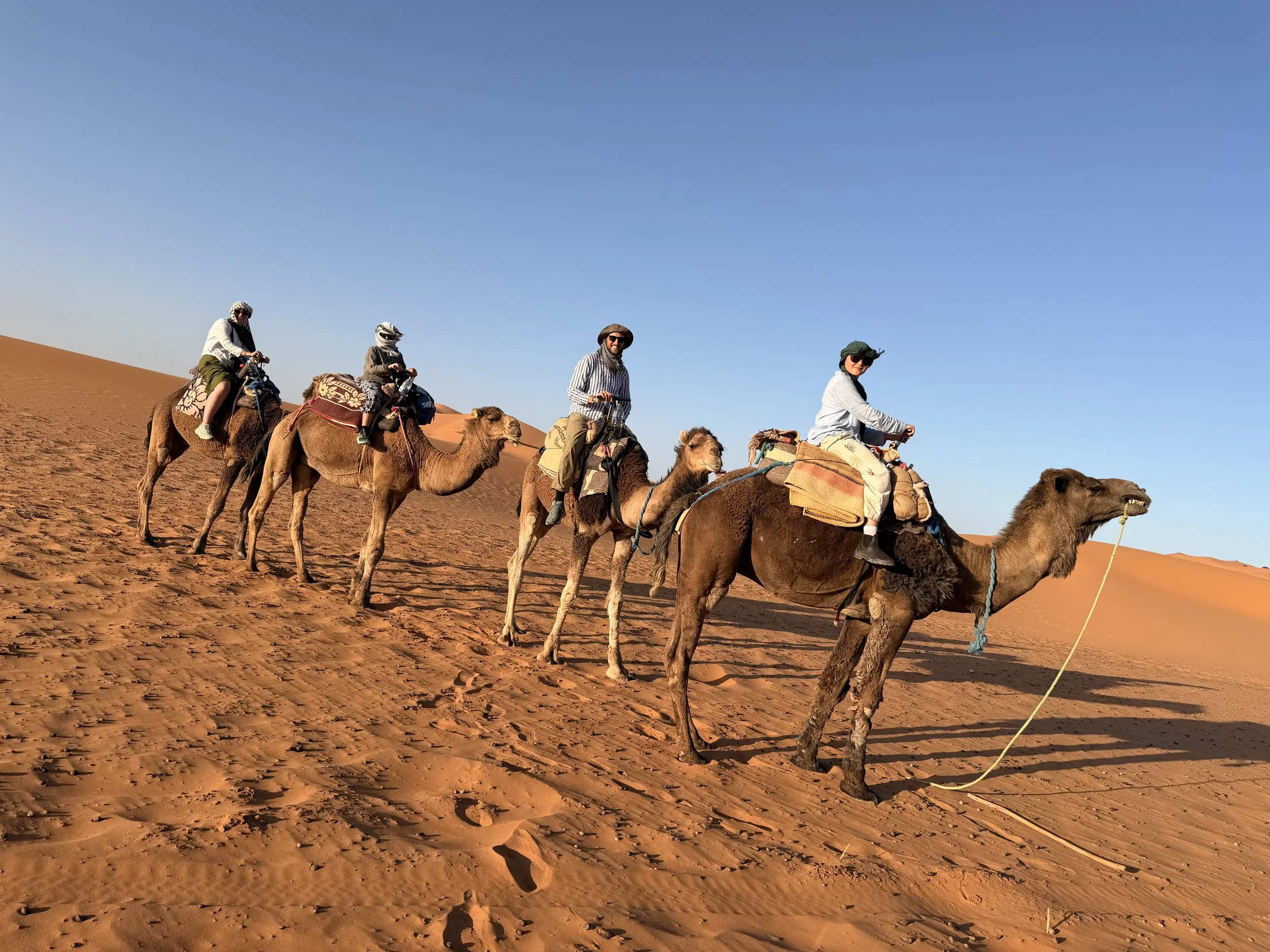
By around 6–6:30pm, we finally arrived at the camel staging point near Merzouga and the Erg Chebbi dunes. We were running late, so everything was rushed. Straight onto camels and straight into the dunes to catch sunset.
And honestly… it was epic.
The red sand, endless dunes, camel ride and sunset were exactly what you picture when you imagine the Sahara. The kids absolutely loved it, and we got some incredible photos.
We eventually reached a massive dune where people were sandboarding. Climbing it was brutal. Every step up meant sliding back, shoes filling with sand, legs burning. Emmett wanted me to go first, so naturally I did… and naturally I stacked it almost immediately.
Emmett’s first run, sitting down, was a complete success, all the way to the bottom. Covered in sand and absolutely loving life.
Round two, Maddie joined in. Both kids mostly went down sitting, while I tried for redemption and nearly made it to the bottom before absolutely eating sand again.
By round three, Emmett gave standing up a proper crack and honestly did amazingly well. He probably would have made it the whole way if he hadn’t jumped off when the speed kicked in. Big tumble, huge grin.
As sunset dropped lower, I climbed to the top of the biggest dune hoping for the ultimate view. It was still incredible, but crowded, and to be honest, I think the first dune may have actually been better.
Eventually, we rode the final 20 minutes by camel into camp, arriving around 8pm and starving once again.
Dinner was included and thankfully we got in early. Another Moroccan buffet with lamb, chicken, vegetable tagine, cold potato, carrots, pasta and bread. By this point, food was simply fuel.
Our desert tent was actually surprisingly spacious, with five single beds. We dumped our bags, had showers, then headed out for the evening entertainment: bonfire, traditional music, drumming and dancing in the desert.
By 10pm, we were exhausted. Kia and the kids had a quick dance, then we wandered away from the camp lights hoping for a magical Sahara star show. Unfortunately, the full moon had other plans. Still beautiful, but nowhere near the endless stars we had imagined.
By 10:30pm, we were finally in bed.
A huge day. One of the most visually spectacular days of the trip so far.
And with a 4:30am wake-up tomorrow for sunrise over the dunes… things could get very interesting.